Trend
Customer experience
8 min
Rédigé le
Managing customer incivility: defuse tensions and restore respect

The rise of customer incivility: a structural, not a temporary, phenomenon
It would be tempting to view the rise in incivility as a passing trend, linked to a specific economic or social context. The data suggests otherwise. For several years, verbal and behavioral incidents have been mounting across all sectors that involve direct contact with the public.
Challenging authority figures
For decades, certain professions enjoyed implicit legitimacy: doctors, bankers, lawyers, and administrative agents embodied a form of authority that clients or users naturally accepted. Today, this social contract has deeply eroded. Every decision is open to challenge, every piece of advice is questioned, and every delay is perceived as a failure.
This questioning is not inherently negative—critical thinking is a key value. However, when it translates into disrespectful or aggressive behavior, it creates a breeding ground for incivility.
Immediacy and the culture of instant criticism
Social media has profoundly transformed how we express dissatisfaction. A negative review posted in seconds, a scathing comment on Google or Trustpilot, a viral video of "bad service": all of this has normalized an emotional reactivity that now spills over into face-to-face exchanges. The culture of instant criticism bleeds into physical interactions, where nuance gives way to polarization.
A more fragmented society with fewer shared references
Beyond digital tools, social cohesion itself is at stake. In a more divided society where common reference points are crumbling, the implicit codes of politeness and mutual respect are becoming less universal. What one person considers normal behavior, another experiences as an attack. Temperance—the virtue of measure and moderation—is becoming rare in professional exchanges as well as in public life.
The impacts of customer incivility on teams and organizations
Managing customer incivility is not just about comfort at work. It is a matter of health, performance, and retaining talent.
Relational exhaustion: an underestimated risk
Dealing with hostile or disrespectful behavior on a daily basis is exhausting. Customer relations professionals gradually develop what occupational psychologists call "emotional exhaustion": the ability to mobilize emotional resources to face difficult situations diminishes with every confrontation. According to the INRS (National Research and Safety Institute), tense situations with the public are among the main factors of psychosocial risk in companies.
In the most severe cases, this exhaustion leads to burnout. Some professionals consider leaving their position, or even their profession, to escape relational conditions that have become unbearable. The human and economic cost is considerable.
Banalization: the most insidious risk
The most silent danger is not the isolated violent incident, which is detectable, trackable, and manageable. It is the gradual normalization of daily micro-incivilities: the condescending tone, the repeated interruption, the inappropriate comment. When these behaviors become "normal," they imperceptibly undermine mutual respect, weaken team cohesion, and erase collective standards.
An organization that normalizes incivility sends an implicit message to its people: your relational well-being is less important than immediate customer satisfaction. This message is destructive in the long term.
Managing customer incivility: 4 operational levers to defuse tension
At Altival, we have developed a practical educational approach to help teams face customer incivility without losing their footing. It relies on four complementary levers.
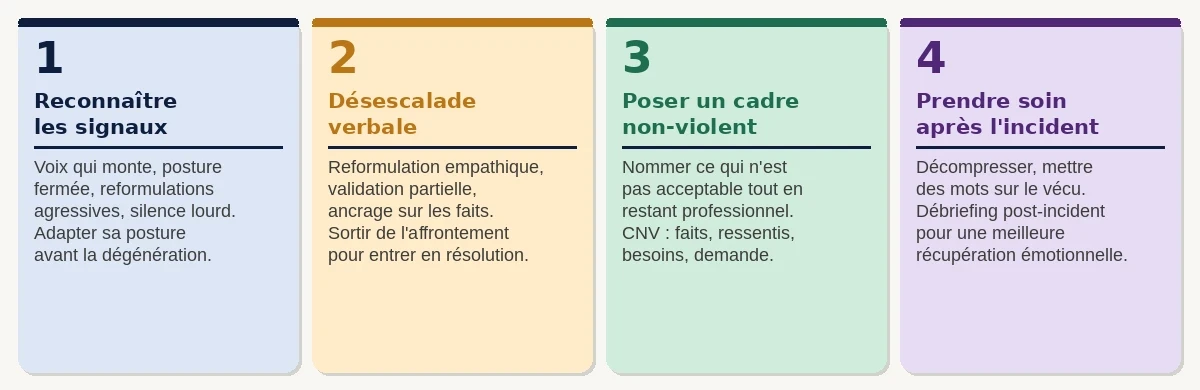
1. Recognize the early warning signs
Incivility rarely comes out of nowhere. It is often preceded by weak signals: a rising voice, closed body language, aggressive rephrasing, heavy silence. Training your teams to identify these early signs allows them to adjust their posture before the situation escalates. The goal is not to neutralize the customer's emotion, but to avoid being infected by it.
2. Apply verbal de-escalation techniques
Verbal de-escalation relies on specific techniques: empathetic rephrasing, partial validation of frustration, anchoring the conversation on facts rather than emotions, and using "I" instead of "you" statements. These tools allow you to step away from confrontation and move toward resolution.
A concrete example: when faced with a customer shouting "you never do anything right," an effective response is not defensive justification, but acknowledgment: "I understand that this situation has caused difficulties for you. Let me look into what happened and see what we can do."
3. Set clear, non-violent boundaries
Defusing tension does not mean accepting all behavior. Knowing how to set boundaries—meaning clearly naming what is unacceptable while remaining professional—is a key skill. Non-Violent Communication (NVC) offers a structured framework to express boundaries without aggressiveness: observe the facts, state your feelings, express your needs, and make a concrete request.
This is precisely the focus of our training programs on managing incivility: giving teams concrete tools to maintain respectful boundaries, even under pressure, without losing their assertiveness.
4. Take care of yourself after the incident
Managing incivility does not end when the interaction does. Professionals who have gone through a difficult situation need to decompress, talk through what happened, and have their experience acknowledged. Organizations that implement post-incident debriefing rituals, even brief ones, see better emotional recovery and a lower risk of exhaustion.
Collective responsibility: restoring meaning to respect
Managing customer incivility is not just the job of frontline staff. It requires the commitment of the entire organization.
Managers play a crucial role: setting clear boundaries on what is acceptable, supporting their teams after difficult incidents, and taking reports seriously. An organization that treats incivility as mere "anecdotes" ends up normalizing the unacceptable.
Leadership teams have a responsibility to train. Investing in training programs to manage incivility sends a strong message: our people's relational health is a priority. It is also a smart investment, as a team member who knows how to handle difficult situations is more effective, takes fewer sick days, and stays with the organization longer.
Every sector can re-establish standards. Restoring balance to our professional exchanges is a powerful lever for teams, customers, and the quality of service provided. Discover how Altival supports this transformation on our training programs on managing incivility page.
FAQ — Frequently asked questions about managing customer incivility
What qualifies as customer incivility?
Customer incivility refers to any behavior that lacks respect for a professional: aggressive tone, insults, repeated interruptions, threats, or any form of pressure aimed at obtaining special treatment. It differs from a legitimate complaint by the total disregard for basic relational codes.
How do you react to an aggressive customer without getting upset?
The key is to separate the customer's emotion from your own emotional reaction. Helpful techniques include mindful breathing to stay grounded, empathetic rephrasing to acknowledge feelings without giving in, and factual reframing to step out of the confrontation. These reflexes are learned and practiced in our training programs.
Is customer incivility on the rise?
Yes. The 2023 BVA barometer indicates that 44% of employees in public-facing roles experienced at least one instance of incivility during the year. The INRS ranks tension with the public among the main factors of psychosocial risk. The trend is structural and affects all sectors.
How can you train your teams to manage incivility?
An effective training program combines theoretical insights on the mechanics of incivility, practical role-playing, work on posture and non-violent communication, and post-incident recovery tools. Altival offers tailored training programs designed for the banking, medical, legal, and administrative sectors.
What is the difference between a conflict and an incivility?
A conflict involves two parties with diverging interests within a framework that can still remain respectful. An incivility, however, violates basic codes of politeness and respect. You can manage a conflict through negotiation; an incivility requires you to re-establish boundaries before any resolution can occur.
Conclusion: managing incivility, a human and strategic investment
The rise in customer incivility is not a trend that organizations are powerless to change. Training your teams, setting clear boundaries, and supporting employees after difficult incidents are concrete actions that make a real difference.
At Altival, we believe that every professional can acquire the tools to defuse tension without feeling overwhelmed. Because restoring meaning to respect starts with empowering those on the front lines, with empathy, methodology, and confidence.
RECOMMENDED SOURCES
1. INRS — Psychosocial risks and tensions with the public
2. BVA / Ministry of Labor — 2023 Working Conditions Barometer
The 6 steps to defuse incivility
Take action
A 30-minute conversation helps clarify what’s relevant for your teams.