Trend
Employee experience
10 min
Rédigé le
Resistance to change in training programs: understanding the paradox to better guide people through it

What science says about resistance to change in training
Resistance to change is a well-documented phenomenon. According to a McKinsey study (2023), nearly 70% of transformation projects fail mainly because of human resistance, not technical issues. In a professional training context, the finding is similar: according to the 2023 Training Barometer, 38% of employees say they do not put into practice what they learn in their training programs. The main reason given? A perceived gap between the new method and their work habits.
These numbers do not reflect a lack of motivation, but a deep cognitive mechanism. Our brain does not work like an objective machine that passively accumulates information. It builds landmarks, habits, mental frameworks that help it navigate the world without becoming overwhelmed. Changing means breaking those landmarks—and that creates real discomfort.
Schrödinger's paradox applied to training
Our facilitator uses a particularly vivid metaphor to illustrate this phenomenon: Schrödinger's cat paradox. As long as the box remains closed, the cat is both alive and dead, reality remains undetermined. In the same way, as long as a learner does not open the « knowledge box », their convictions remain intact. But when it opens, questioning becomes inevitable.
It is precisely this moment of opening that generates resistance to change in training: the learner must simultaneously integrate a new skill and accept that their old practice was imperfect.
Semmelweis's example: when learning rhymes with guilt
This resistance to change runs through the history of science. In the 19th century, Hungarian doctor Ignaz Semmelweis demonstrated that washing hands between the autopsy room and the maternity ward drastically reduced maternal mortality (from 10–35% to less than 2%). An obvious truth for us today. Yet his peers overwhelmingly rejected his discovery.
Why? Because accepting this truth would have meant acknowledging that they had, unintentionally, caused the death of many patients. The psychological burden was unbearable. They preferred denial to accepting this cognitive rupture.
The parallel with professional training is direct: when a learner discovers a more effective method, they are not only thinking about the future. They also unconsciously take stock of all the years when they worked differently. And that realization can be painful.
The 4 stages of learning: where does resistance sit?
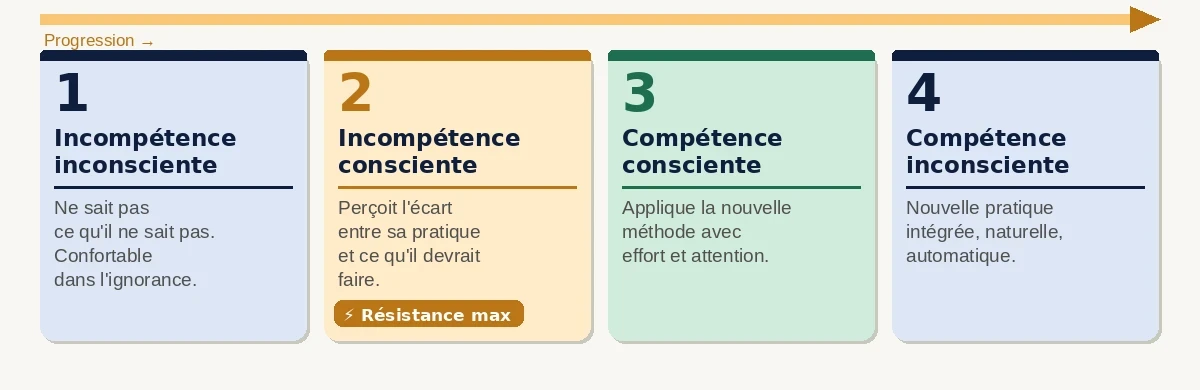
The 4-level skill model, developed in the 1970s, makes it possible to pinpoint exactly when resistance to change in training is strongest:
Unconscious incompetence: the learner does not know what they do not know. They are comfortable in their ignorance.
Conscious incompetence: they suddenly become aware of the gap between what they do and what they should do. This is where resistance is strongest.
Conscious competence: they apply the new method with effort and attention.
Unconscious competence: the new practice is integrated, natural, automatic.
The resistance observed in training almost always appears when moving to the second level. Typical phrases reveal this tension: « It is not suited to our reality », « That does not work with our clients », « We already do it that way, but differently ». These objections do not mean a refusal to learn—they signal a normal and necessary stage in the process.
How to turn resistance to change into a pedagogical lever
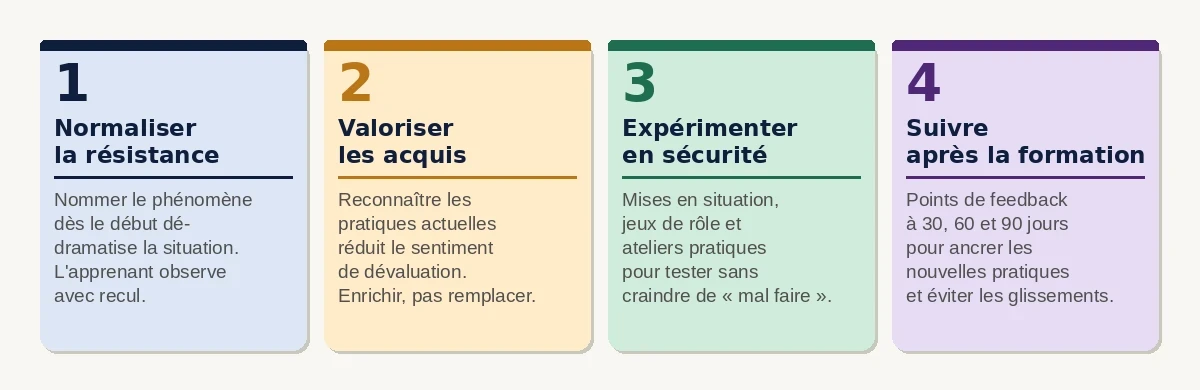
At Altival, we believe that resistance to change is not an obstacle to work around, but a signal to welcome. Here are the four levers our facilitators systematically use:
1. Normalize resistance
Naming the phenomenon at the start of the training removes the drama from the situation. When the learner understands that their resistance is a universal human reaction, not a sign of bad will, they can observe it with perspective instead of being overwhelmed by it.
2. Value existing skills
Explicitly recognizing the value of the learner's current practices reduces the feeling of being devalued. The point is not to replace their skills, but to enrich them. This reframing significantly lowers the psychological cost of change.
3. Create safe spaces for experimentation
It is through practice, in a low-stakes setting, that skill becomes meaningful and confidence grows. Role plays, simulations, and hands-on workshops allow the learner to test the new method without fearing they will « do it wrong ».
4. Ensure rigorous post-training follow-up
Real transformation takes hold over time, well after the session ends. A follow-up at 30, 60, and 90 days, with structured feedback points, makes it possible to anchor new practices and detect drift back toward old habits.
These levers are at the heart of our approach in our communication and soft skills training programs. Developing the ability to communicate assertively, manage relational tensions, or adapt to the person you are speaking with means doing precisely this work on resistance to change — and that is why we give it a central place in our pedagogical design.
Resistance and communication: an underestimated link in the workplace
Resistance to change in training often shows up indirectly: silence during debriefs, vague wording, reverting to old practices as soon as the session ends. These signals are first and foremost communication signals.
A learner who resists is expressing a need in their own way: the need to be understood, to be reassured about the value of what they already know, to have the right to make mistakes. Developing communication skills — especially active listening and assertiveness — helps facilitators detect these signals more effectively, and helps learners express them more clearly.
This is one of the guiding threads in our Altival training programs: strengthening the communication soft skills to create the conditions for learning that is smoother, more lasting, and less psychologically costly for the learner.
FAQ — Frequently Asked Questions about resistance to change in training
What is resistance to change in training?
It is the natural tendency of a learner to maintain existing practices when faced with new methods. It is explained by a cognitive mechanism that protects internal coherence: changing means admitting that one was doing things differently—which can create real psychological discomfort.
How do you distinguish resistance to change from a lack of motivation?
An unmotivated learner invests little in the training. A resistant learner, by contrast, may be highly engaged—but they challenge, argue, and try to show that the new method does not apply to their situation. Resistance is often proof of involvement, not indifference.
Can resistance to change be positive?
Yes. A well-managed resistance is a sign that the learner has become aware of the gap between their current practices and what is expected—that is exactly the second stage of the 4-level skill model. Without that awareness, learning would remain superficial.
How long does the resistance phase last in training?
It varies depending on the individual and the degree of questioning involved. In short professional training sessions (1 to 3 days), resistance often appears at the start of the second half-day. Structured post-training follow-up helps prevent it from reappearing several weeks after the session.
Which teaching tools reduce resistance to change?
Practical simulations, immediate supportive feedback, explicit recognition of existing skills, and peer-group work are the most effective tools. Communication training — especially active listening and emotional management — also plays a key role.
Conclusion: resistance is proof of learning
Resistance to change in training is not a brake — it is a stage. As Semmelweis experienced in the 19th century, what is disruptive is not the truth itself, but its impact on our coherence. Accepting change means accepting to redefine our reference points.
That requires caring support, pedagogy suited to adults, and a shared conviction: resistance is the necessary passage to lasting competence. At Altival, we have made it the heart of our pedagogical design — because training professionals is, above all, about giving them the means to transform with confidence.
Summary Sheet
Take action
A 30-minute conversation helps clarify what’s relevant for your teams.